Beginner guide14 min
Learn SQL: the complete beginner's guide
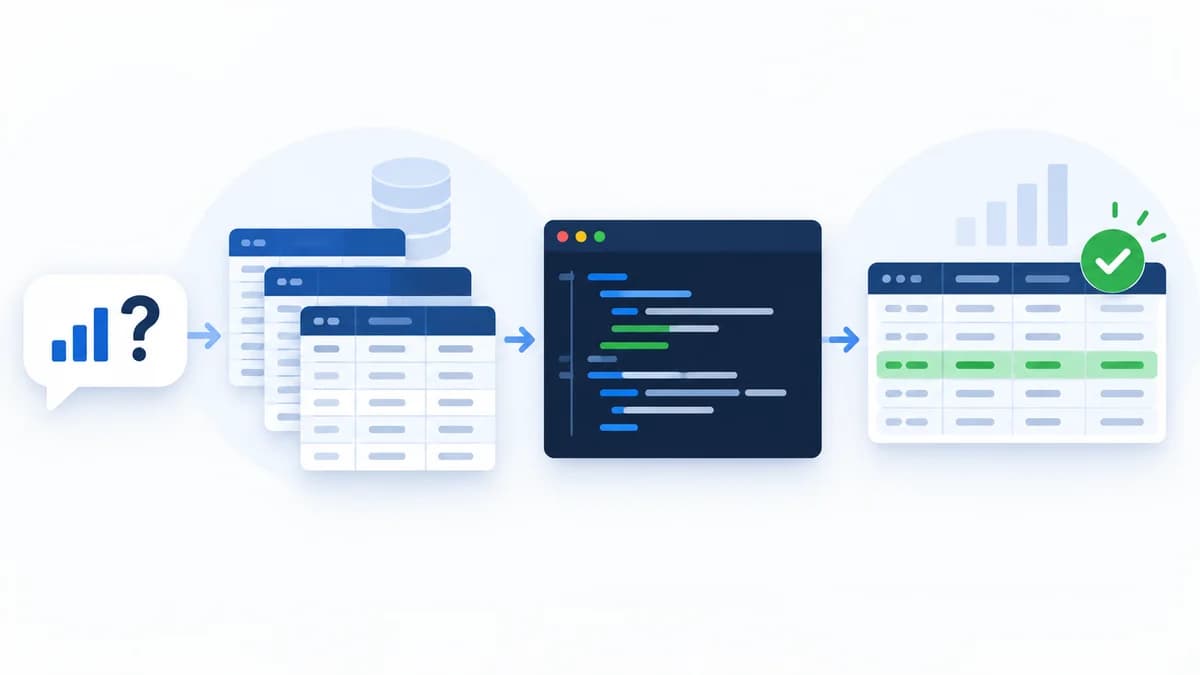
A step-by-step method for moving from a business question to a reliable query, even if you've never used a database.
Read the articleSQL guides
Every guide includes a verified example, common mistakes to avoid and a practical next step.
A step-by-step method for moving from a business question to a reliable query, even if you've never used a database.
Read the article
A training method and three exercises explained to progress without transforming the correction into a simple copy and paste.
Read the article
These three tools protect data at different times. Confusing them adds complexity without improving reliability.
Read the article
The difference seems small, but it can change a completeness or volume KPI.
Read the article
The right choice does not depend on a duel between tools, but on the way in which your data lives and is shared.
Read the article
Three apparently similar operators respond to three different business intentions.
Read the article
SQL does not start with SELECT. It begins when multiple people and systems need to share reliable facts.
Read the article
A database is not only used to return rows: it structures and protects the functioning of entire applications.
Read the article
SQL is a language; A database is the system that stores information and executes queries.
Read the article
SQL is the common language; PostgreSQL, MySQL and SQL Server are engines with their own dialects and tools.
Read the article
WHERE defines the calculation lines; HAVING decides which calculated groups remain visible.
Read the article
Both structure a query; the best form is the one that makes the business steps testable.
Read the article
Both can return a row per value, but their intent is not the same.
Read the article
join does not always create an error: it often reveals a poorly anticipated one-to-many relationship.
Read the article
The choice depends first on which lines should remain visible, not on a syntax preference.
Read the article
High revenue does not guarantee high margin: the two indicators must be defined separately.
Read the article
Transform a business rule into a readable column without modifying the source data.
Read the article
The choice becomes simple when you distinguish membership in a list and the existence of a relationship.
Read the article
Handle missing values explicitly to produce reliable filters, calculations and reports.
Read the article
Connect two tables without duplicating data with a clear and verifiable join condition.
Read the article
Transform sales lines into reliable indicators by city, category or period.
Read the article
Just three keywords are enough to start turning a table into a useful answer.
Read the article